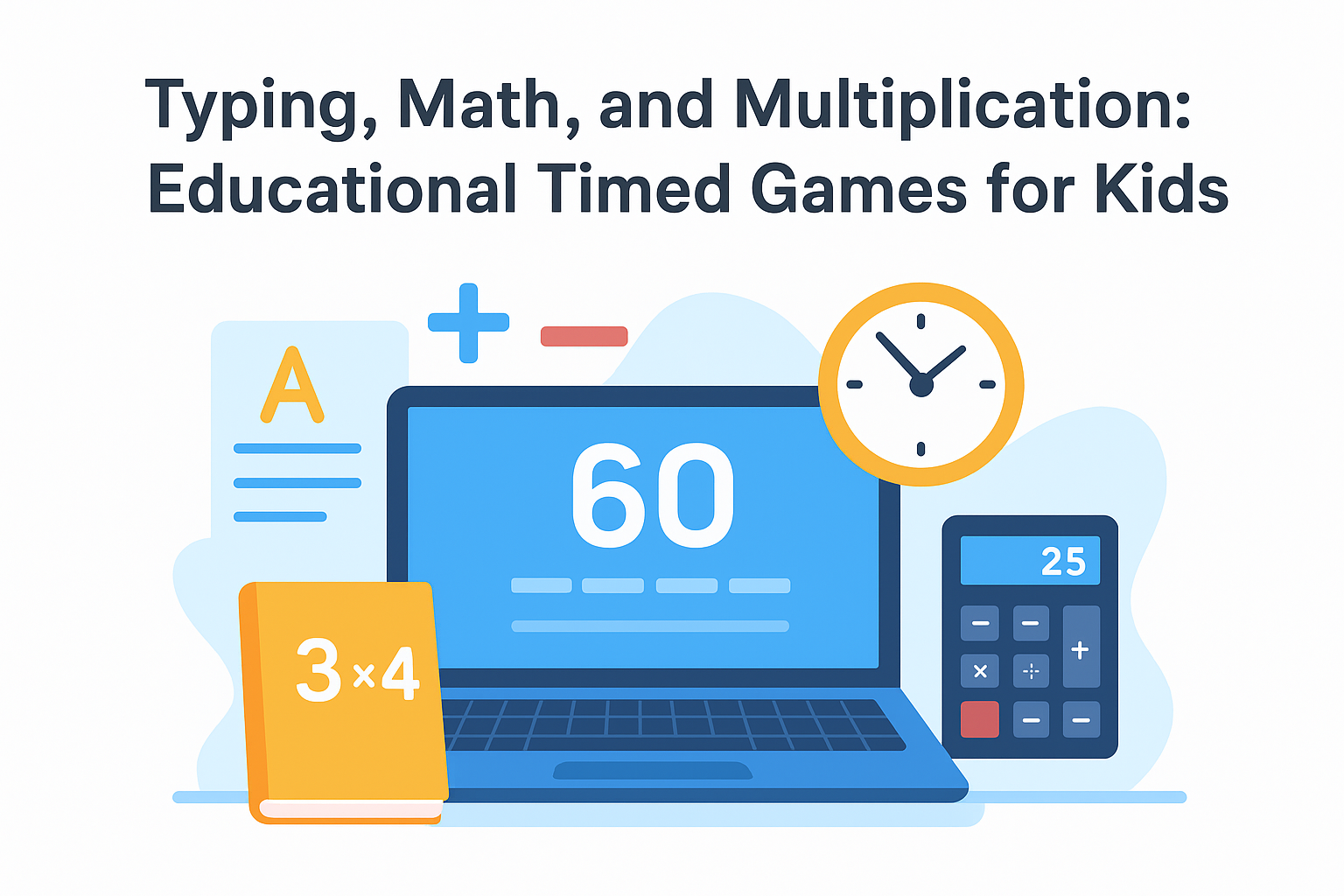
15 Fun Math Games for Kids and Adults (That Make Learning Addictive!)
“Math isn’t about memorizing numbers; it’s about discovering patterns that make sense of the world.”
Math can feel either magical or miserable depending on how it’s introduced. Many of us remember anxiety before a test, the dread of long divisions, or the confusion of symbols that didn’t connect to real life. But what if mathematics was taught as a game—something that triggers the same excitement as scoring a goal or finishing a level? That’s what modern math games do. They transform abstract logic into fast-paced discovery, suitable for both kids and adults who want sharper focus, faster thinking, and confident problem-solving.
Across classrooms, living rooms, and mobile screens, thousands of people are rediscovering the joy of numbers through play. Parents report better attention spans; teachers notice improved retention; adults use them as mental fitness tools. Whether you have two minutes between meetings or want a weekend family challenge, the following fifteen games combine fun with measurable learning outcomes.
Let’s start with the flagship title that perfectly captures this philosophy.
#1. Math Champs – Math Games Duo 🎯
Platform: Android Developer: BrightMind Games Category: Timed Math Challenge
Overview:Math Champs – Math Games Duo is built for quick bursts of competition and deep learning at once. Each match lasts just two minutes, yet the adaptive difficulty system ensures continuous engagement. Kids feel accomplished as questions evolve from single-digit addition to multi-step reasoning; adults treat it as mental cardio, racing against reflex-testing timers. The interface is vibrant, responsive, and intentionally distraction-free so attention stays on numbers, not noise.
Gameplay: Select a mode—Addition, Subtraction, Multiplication, Division, or Mixed. Tap through rapid-fire problems as the clock ticks down. A correct streak increases speed and background intensity; an incorrect answer slows the rhythm slightly, preventing frustration. The dual-player “Duel Mode” places two players side by side on one device, encouraging friendly rivalry. Meanwhile, “Coach Mode” provides instant micro-feedback such as “try rounding tens first” or “look for halves,” transforming mistakes into insight.
Why It Works: Short-cycle feedback loops create what neuroscientists call a “dopamine reward schedule.” Every correct response releases a small sense of achievement, keeping motivation steady. By the end of a three-minute round, the player has performed dozens of calculations—essentially a high-intensity interval training session for the brain.
Skills Enhanced: arithmetic fluency • pattern recognition • decision speed • focus under pressure • self-benchmarking. The in-app leaderboard shows daily and weekly progress so improvement feels visible, not abstract.
BrightMind Tip: Treat Math Champs like meditation. Two minutes each morning before work or school sharpens focus for hours. Teachers use it as a warm-up exercise; professionals use it to reset between tasks.
#2. The 24 Game 🧩
Best For: Ages 8 and up Format: Card or dice game Core Skill: Flexible arithmetic thinking
Few games train numerical creativity as effectively as the 24 Game. You receive four numbers—say 4, 7, 3, 2—and must combine them using +, −, ×, ÷ exactly once to make 24. There’s no single route: 7 × (4 − 3) × 2 = 14? Too low. 7 − 3 = 4; 4 × 2 × 3 = 24—success! Each trial pushes the brain to juggle possibilities, building mental flexibility essential for algebra and calculus later on.
How to Play: Shuffle a deck of number cards. Place four face-up. Shout or write the first valid equation that equals 24. Correct answers earn the card; wrong answers lose a turn. Add a 60-second timer to replicate classroom adrenaline. For advanced rounds, include fractions or exponents.
Educational Value: Encourages order-of-operations mastery and experimentation. Players quickly learn that rearranging terms often reveals hidden pathways—a practical lesson in mathematical structure.
#3. Nerdle 💻
Platform: Web & Mobile Audience: Puzzle lovers age 10 + Learning Focus: Equation logic and syntax
Nerdle applies the addictive daily-challenge format of Wordle to numbers. The goal is to uncover a hidden equation within six tries. Each guess must be a mathematically correct statement—like “8 / 4 + 3 = 5.” After submission, tiles change colors: green means correct digit and position; purple means the element exists but is misplaced. Through pattern elimination, players develop algebraic reasoning unconsciously.
Why Adults Love It: It demands precision and balance. You can’t rely on vocabulary intuition; you must think about structure. For many, it’s the first time algebra feels like Sudoku. Teachers use it as a bell-ringer activity; professionals play it during coffee breaks to reboot logic circuits.
Timed Variant: Enable “Lightning Mode.” Each puzzle must be solved within 90 seconds. Track average completion time over a week to visualize progress. The cognitive benefit mirrors rapid problem-solving used in aptitude tests.
#4. Math Dice 🎲
Platform: Physical set or mobile simulation Players: 2 – 6 Goal: Reach the target number exactly or get closest
Roll one Target die—say a 12-sided showing 18—and five regular dice for building blocks. Players combine those numbers using any operations to reach 18. Someone may try (6 × 3) = 18, another (10 + 8) = 18, another (20 − 2). If nobody hits it exactly, the closest wins the round.
Learning Outcome: Estimation and mental computation without paper. By mixing chance (dice rolls) with strategy (mathematical combination), players stay engaged even when they lose. It cultivates the ability to approximate quickly—a crucial skill in real-world finance and engineering.
Classroom Variation: Group students into pairs. Each team writes its equation on a whiteboard within 30 seconds. Award bonus points for creative use of all dice.
#5. Equate – The Equation Board Game 📐
Concept: Scrabble meets Math Best For: Families & teachers seeking group learning sessions
Equate uses tiles showing numbers and operations to form true equations on a crossword-style board. Each tile placed must maintain mathematical truth—no approximation allowed. Players score based on complexity and placement on premium squares like “Double Equation” or “Triple Product.” It’s tactile, social, and conceptually rich.
How It Builds Understanding: Because every move is peer-verified, learners develop a habit of checking validity—a foundational mathematical practice. Strategic thinking is rewarded as much as speed. Players weigh whether to place a short equation for quick points or save tiles to build a larger one later.
Advanced Play: Introduce negative numbers and square roots after round three. Adults can use it as a friendly logic night game paired with Sudoku or crossword sessions.
#6. DragonBox 🐉
Platform: iOS / Android Genre: Visual puzzle learning Recommended Ages: 5 – 12 (kids) and adults who enjoy visual logic
DragonBox revolutionized how algebra is taught. Instead of explaining rules, it lets players discover them through play. Each level presents a “box” split into two sides containing creatures and numbers. Feed items to both sides to keep balance—soon the player realizes they’re isolating variables and simplifying equations without any notation. It’s learning through intuition, not instruction.
Impact on Learning: Multiple studies show that conceptual understanding built through visual metaphors lasts longer than rote memorization. DragonBox uses that principle brilliantly, introducing negatives, fractions, and distributive logic as natural extensions of gameplay. By the final levels, players can solve traditional algebra questions because they already internalized the relationships.
For Adults: The game’s later chapters offer a peaceful brain exercise. The calming music and gradual complexity turn problem-solving into a form of digital zen.
#7. Prodigy Math Game 🧙♂️
Platform: Web / Mobile Target Audience: Elementary and middle school students Genre: Adventure RPG with curriculum math
Prodigy Math Game blends fantasy quest mechanics with academic practice. Players explore a colorful world battling creatures through math duels. Each correct answer casts a spell; each mistake reduces energy. As players advance, they earn pets, gear, and rewards that drive sustained engagement.
Educational Integration: Teachers use Prodigy as a homework and assessment tool. The backend dashboard maps every question to curriculum standards (Common Core, CBSE, Cambridge). Educators can assign specific topics and track accuracy metrics. Because it feels like gaming rather than testing, students practice voluntarily—often completing far more questions than in traditional assignments.
Family Use: Parents can create linked accounts and join quests co-operatively. Adults often find themselves hooked too; the game doubles as a mental refresh after a workday. Its storyline and color palette keep anxiety low while maintaining challenge.
Life-long Learning Benefit: Regular exposure to math in positive contexts rewires emotional association with numbers. Prodigy’s design philosophy aligns closely with BrightMind’s approach—reduce stress, increase streaks, and celebrate micro-wins.
Continue to Part 2 → Games 8 to 15, Why Math Games Matter & BrightMind Spotlight.